

Few things are more confusing, exhausting, and deeply frustrating than pulling back your covers after a long day, only to find a wet spot. If you find yourself desperately wondering, why does my dog pee on my bed, you are absolutely not alone. It is a moment that tests the patience of even the most devoted pet parent.
Most owners immediately stand there staring at the wet mattress, thinking the exact same thing: “Is my dog angry at me?” “Did I do something wrong?” “Why would they choose my bed when they know exactly where the backyard is?”
After talking with hundreds of dog owners online, I’ve noticed a distinct pattern. Most people assume their dog is being spiteful when they soil the mattress. Yet after a veterinary exam, many discover the real cause was something entirely physical, such as a urinary tract infection or age-related incontinence.
The absolute key to stopping this incredibly stressful dog behavior problem is figuring out exactly which trigger applies to your dog. In this comprehensive guide, we will explore the real reasons behind dog bed wetting, how to distinguish between a behavioral issue and a medical emergency, and what you can do to permanently protect your mattress.
A dog pees on the bed due to medical issues like urinary tract infections (UTIs), incontinence, or age-related dementia. Behaviorally, it is caused by anxiety, stress, or territorial marking. Because beds are soft, elevated, and smell strongly of their owners, they become a prime target for dogs seeking physical comfort or emotional security when they lose bladder control.
Why Did My Housebroken Dog Pee on My Bed?
This is the most common question that leaves dog owners completely baffled. A completely house-trained dog that suddenly has an accident indoors, specifically on a bed, is almost always experiencing an acute medical or emotional change.
To understand why this happens, we have to look at how veterinarians approach the problem. “When a house-trained dog suddenly begins urinating on the bed, we always recommend ruling out medical causes first,” say many veterinary behavior specialists. “Behavioral explanations should come after a medical evaluation, not before.”
If a dog is housebroken, they understand the rules of the house. Breaking those rules means something has overridden their training. A sudden, agonizing urge to go leaves them with no time to reach the back door. In a moment of panic or pain, the soft, absorbent bed feels like a safe, comforting place to relieve the pressure.
Should I Punish My Dog for Peeing on My Bed?
No. Absolutely not under any circumstances.
In fact, one of the most common mistakes owners make is bringing their dog into the bedroom, pointing at the wet spot, and yelling or rubbing the dog’s nose in it. Punishment is one of the fastest ways to make the situation infinitely worse.
Dogs simply do not possess the cognitive ability to connect your current anger with an accident that happened hours, or even minutes, earlier. Their brain does not link the puddle to the scolding in a logical way.
What they often learn instead is:
- Peeing around humans is terrifying and dangerous.
- Their owners have become unpredictable and scary.
- Hiding their accidents (like peeing behind the sofa, deep in a closet, or on a spare bed) is a safer option.
If you catch your dog in the act, calmly interrupt them with a sharp “Ah-ah!” or a gentle clap, and immediately lead them outside to finish. If you find the mess later, focus your energy on discovering why it happened, not assigning blame.
Most Common Causes at a Glance
If you are rushing to figure out what is wrong, use this quick reference table to narrow down your dog’s symptoms before diving into the detailed medical and behavioral breakdowns:
| Cause | Usually Sudden? | Vet Visit Needed? |
|---|---|---|
| Urinary Tract Infection (UTI) | Yes | Yes (Requires antibiotics) |
| Bladder Stones | Yes | Yes |
| Anxiety & Stress | Sometimes | Maybe (For severe cases) |
| Territorial Marking | No | Usually No (Behavioral) |
| Senior Dog Dementia | Gradual | Yes (Management needed) |
| Spay Incontinence | Yes | Yes (Needs medication) |
| Diabetes / Kidney Disease | Gradual | Yes |
11 Common Causes: Why Does My Dog Pee on My Bed?
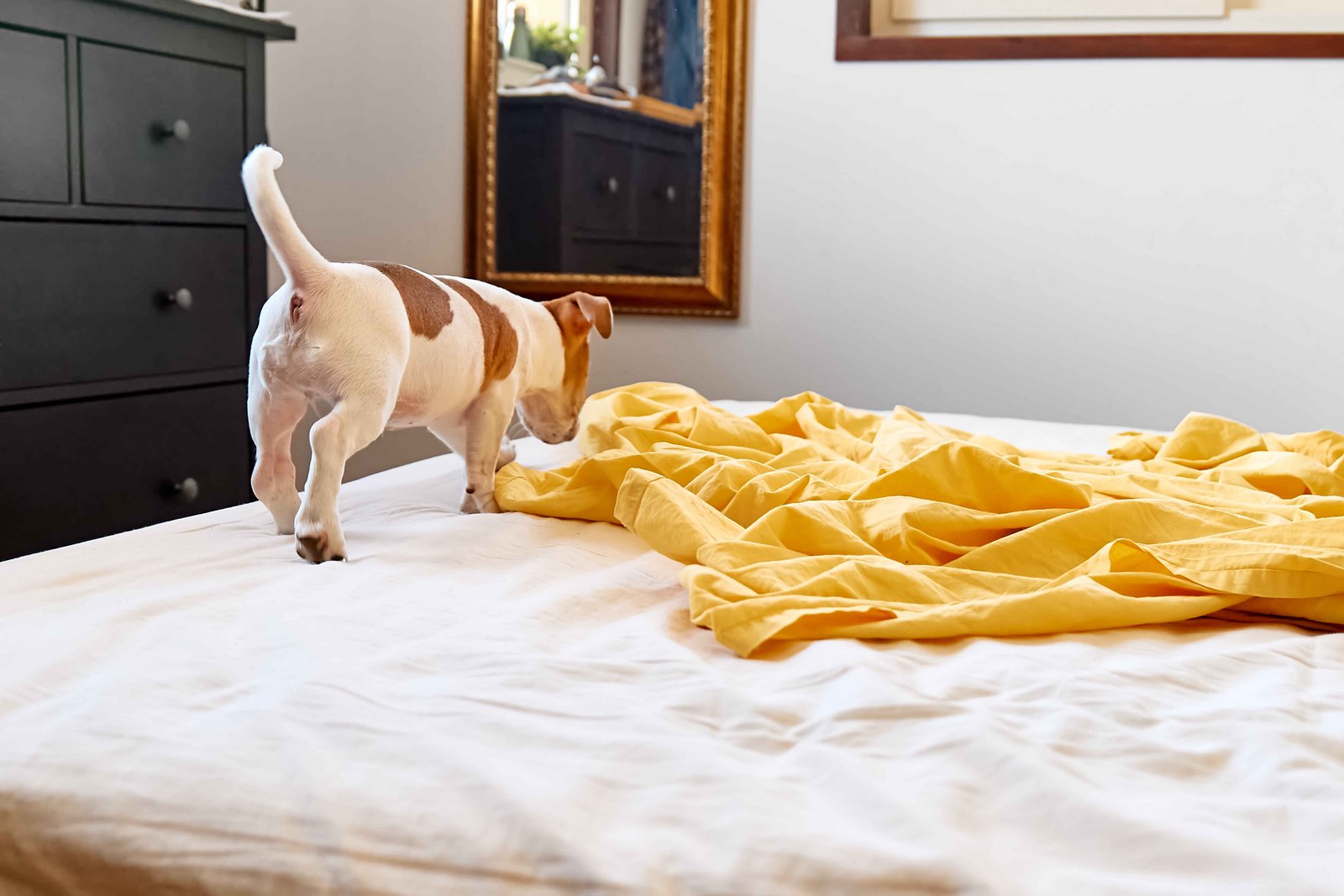
Many owners immediately assume bed wetting is a behavioral problem, believing their dog is acting out or that they’ve failed to properly train their pets. In reality, medical issues are often the primary cause. If you are constantly wondering why does my dog pee on my bed, here are the 11 most common reasons behind this frustrating behavior.
1. Urinary Tract Infections (UTIs)
Urinary tract infections are incredibly common, especially for indoor female dogs. UTIs cause severe inflammation, a burning sensation, and a sudden, uncontrollable urge to urinate. If your dog suddenly pees on your bed while wide awake, and you notice them licking their genitals constantly, a UTI is the most likely culprit.
2. Spay Incontinence (Urethral Sphincter Hypotonus)
Many owners are surprised to learn that poor bladder control following a spay surgery is a very real physical disorder. When a female dog is spayed, her ovaries are removed, leading to a drastic drop in estrogen over time. Estrogen is essential for keeping the urethral sphincter muscle strong and tightly closed.
Without adequate estrogen, the muscle relaxes too much, releasing a puddle of urine whenever the dog drifts off to sleep. Leaking urine during rest is absolutely not your dog’s fault.
3. Bladder Stones and Crystals
Hard mineral deposits can form in the bladder due to dietary imbalances, genetics, or chronic UTIs. These bladder stones constantly scrape and irritate the delicate bladder lining. This gives the dog a chronic, agonizing feeling of needing to “go” immediately.
4. Diabetes Mellitus
Diabetes dramatically affects a dog’s body and its ability to regulate blood sugar and water. Dogs with diabetes will experience extreme, unquenchable thirst and a massive increase in urination. The sheer volume of urine simply makes it impossible for their bladder to hold it through the night.
5. Kidney Disease
As a dog’s kidneys begin to fail or lose function, they can no longer concentrate urine properly. The body flushes water rapidly, forcing the dog to drink excessively and urinate constantly. Bed wetting is often one of the earliest visible warning signs of chronic kidney disease in adult dogs.
6. Arthritis and Mobility Issues
Veterinarians frequently report that large breed dogs suffering from severe osteoarthritis simply cannot physically get out of bed in time. The pain of standing up, walking across hard floors, and navigating stairs to reach the doggy door is too overwhelming. They ultimately choose to wet the bed because it is the less painful option.
7. Separation Anxiety and Stress
Anxiety is a massive trigger for inappropriate urination. If you work long hours, your dog may suffer from severe dog separation anxiety. A dog will specifically pee on your bed because it is entirely saturated with your scent. When they are panicking about being left alone, mixing their scent with yours on the bed provides a misguided sense of safety.
8. Territorial Marking
Unlike a full bladder release, territorial marking is highly deliberate. Marking is driven by instinct, hormones, and environmental insecurity. A dog that leaves a few small drops or a quick spray in the exact same location repeatedly is often marking territory.
9. Submissive or Excitement Urination
Submissive urination occurs when a dog pees out of extreme submission or fear, especially if they are being scolded or approached too quickly. Conversely, some dogs lose muscle control simply because they are overly excited to see you when you wake up in the morning.
10. Incomplete House Training
Sometimes, the simplest answer is the right one. If you have a young puppy or a newly rescued shelter dog, they may simply not be fully potty trained yet. To a dog that doesn’t understand the rules, a plush mattress feels remarkably similar to soft grass.
11. Environmental Changes
Dogs are creatures of habit. Construction outside, a new work schedule, a visiting relative, or even rearranging the bedroom furniture can deeply unsettle a sensitive dog, prompting behavioral house soiling.
Real-Life Case Examples
The “Sudden UTI”
Sarah’s 6-year-old Beagle had been house-trained for years and had never had an accident indoors. Then, over one weekend, he peed on her bed twice.
She initially assumed it was behavioral, perhaps acting out because she had been working late. However, a veterinary visit revealed a severe urinary tract infection. After a simple course of antibiotic treatment, the accidents stopped completely and immediately.
The Senior Dog
An elderly Golden Retriever began peeing on the bed at night despite years of perfect house manners. His owners were frustrated and confused, wondering if he was losing his memory.
The cause wasn’t stubbornness or dementia, it was severe arthritis in his hips. Getting up, maneuvering off the elevated bed, and walking downstairs had become incredibly painful, so he started having accidents exactly where he slept to avoid the physical agony of moving.
Why Does My Dog Keep Peeing on My Bed?
If you have ruled out acute medical emergencies like a UTI, but the behavior continues, you are dealing with a chronic issue. When a dog repeatedly and consistently pees on the bed, it usually points to one of three ongoing problems:
1. Untreated Spay Incontinence: If she leaks in her sleep every single night, she needs daily hormone or muscle-tightening medication.
2. Deep-Rooted Anxiety: If your dog only pees on the bed when you leave the house, the chronic stress of separation anxiety is overriding their house training.
3. The Smell is Still There: If a dog pees on a bed once, and the mattress is not cleaned with a heavy-duty enzymatic cleaner, the uric acid crystals remain. To a dog’s sensitive nose, that spot now smells like a designated bathroom, and they will keep returning to it.
How Do I Stop My Dog From Urinating on My Bed?
Once medical issues are officially addressed or ruled out by your vet, there are active, proven steps you can take at home to prevent your dog from peeing on the bed while you sleep or while you are at work.
Restrict Access Immediately
The fastest way to stop the behavior is to remove the opportunity. Close your bedroom door when you are not home. If your dog sleeps with you, it may be time to transition them to a dog bed on the floor or utilize baby gates to keep them out of the room unsupervised.
Utilize Crate Training
If the bed wetting is behavioral or due to incomplete house training, crate training is highly effective. Dogs naturally possess a denning instinct and will go to great lengths to avoid soiling their sleeping quarters. Make the crate a positive, highly rewarding space, and have them sleep there instead of on your mattress.
Monitor Evening Water Intake
Monitoring your dog’s water intake can help prevent nighttime accidents. Make sure your dog has unlimited access to fresh water throughout the day, but consider picking up the water bowl two hours before bedtime. (Note: Never restrict water for dogs with diabetes or kidney disease without explicit veterinary permission).
Establish a Consistent Potty Routine
Dogs thrive on strict routines. Make sure the absolute last thing you do before getting into bed is taking your dog outside for a final, unhurried bathroom break. Stand with them to ensure they actually empty their bladder rather than just sniffing the grass.
Use Belly Bands and Dog Diapers
For senior dogs suffering from incurable incontinence or dementia, management is the kindest approach. Washable belly bands (for males) and doggie diapers (for females) will protect your bed. They allow your dog to continue sleeping closely by your side without anxiety or mess.
🚨 Call Your Vet Immediately If:
While some accidents are purely behavioral, urinary issues can escalate quickly into life-threatening emergencies. Do not wait to see a vet if you notice the following:
- Your dog is straining to urinate: They posture repeatedly but nothing comes out.
- You see blood in the urine: The puddle is pink, red, or rust-colored.
- Your dog cannot urinate at all: This is a medical emergency indicating a deadly blockage.
- They seem lethargic or painful: They are crying, shivering, or refuse to eat.
- The accidents started suddenly and frequently: Going from perfect house manners to multiple accidents a day.
What Scent Stops Dogs From Peeing?
Many people search the internet for magical scents that stop dogs from peeing on furniture or beds. Unfortunately, there is no universally effective smell that permanently prevents urination.
Citrus, white vinegar, rubbing alcohol, and commercial deterrent sprays may discourage some dogs temporarily because they dislike the sharp odor. However, they do not address the underlying cause.
If the reason your dog is peeing on the bed is medical, anxiety-related, or driven by territorial marking, the behavior will usually continue, either on the bed once the spray wears off, or on the rug right next to it, until the root issue is actually solved.
Is My Mattress Ruined If My Dog Peed on It?
Not necessarily.
If you clean the urine quickly using the correct method, most mattresses can be saved. The biggest threat isn’t the visible stain, it’s the uric acid crystals left behind, which can continue producing a sharp, ammonia-like odor for months if not properly removed.
To save your mattress, you absolutely must use an enzymatic cleaner. Standard laundry detergents and dish soaps only mask the scent. Here is how to clean it properly:
- Blot, Don’t Rub: Use heavy paper towels to soak up as much liquid as possible. Press down firmly, but do not scrub, which pushes the urine deeper into the mattress padding.
- Saturate with Enzyme Cleaner: Spray a high-quality pet enzymatic cleaner directly onto the stain. You need to soak it deeply enough to reach wherever the urine penetrated.
- Let it Dwell: The enzymes need time to physically “eat” the odor-causing bacteria. Let it sit for at least 15 to 20 minutes.
- Blot Again and Air Dry: Blot up the excess moisture and let the mattress air dry completely. Once dry, cover it with a high-quality, waterproof mattress protector to prevent future disasters.
Conclusion
If there’s one thing I’d want dog owners to remember, it’s this: dogs do not usually pee on beds out of revenge. Finding out exactly why does my dog pee on my bed requires patience and understanding.
In almost all cases, they’re either struggling physically with a painful medical issue, feeling deeply stressed, or trying to communicate that something in their environment has fundamentally changed.
The sooner you identify the underlying reason, starting with a thorough veterinary checkup, the faster you can solve the problem, offer your dog the relief they need, and get back to sleeping peacefully in a dry bed.
References & Scientific Further Reading
- PetMD: Urinary Tract Infections (UTIs) in Dogs: Signs, Causes, and Treatments
- VCA Animal Hospitals: Separation Anxiety in Dogs and Behavioral Soiling
- Merck Veterinary Manual: Non-neurogenic Disorders of Micturition and Incontinence in Dogs
- American Kennel Club (AKC): How to Crate Train Your Dog to Prevent Indoor Accidents
Frequently Asked Questions (FAQ)
Why did my house-trained dog suddenly pee on my bed?
A completely house-trained dog that suddenly pees on the bed is almost always suffering from an acute medical issue, such as a urinary tract infection (UTI), bladder stones, or age-related incontinence. It can also be triggered by sudden, severe emotional stress or a major change in their daily environment.
Is peeing on the bed behavioral?
It can be. While medical issues should always be ruled out first, behavioral peeing is very common. Dogs will pee on beds due to intense separation anxiety, fear, submissive urination, or to territorial mark their environment if they feel insecure about a new pet or person in the home.
Should I punish my dog for peeing on my bed?
Absolutely not. Punishing your dog is counterproductive and harmful. If it is a medical issue, they literally cannot control their bladder. If it is behavioral, punishment increases their fear and anxiety, which only makes the bed wetting worse and teaches them to hide their accidents from you.
Why does my old dog pee on the bed?
Senior dogs often pee on the bed due to a natural loss of bladder sphincter muscle tone (incontinence), painful arthritis that makes getting out of bed too difficult, or Canine Cognitive Dysfunction (dementia), which causes them to become confused and simply forget their house training.
What should I do if my dog peed on my bed?
Stay calm and do not yell. Strip the bed immediately and wash the bedding using a heavy-duty enzymatic cleaner to permanently destroy the uric acid crystals. Then, restrict your dog’s access to the bedroom and schedule a veterinary appointment to rule out hidden medical conditions.
How do I stop my dog from peeing on my bed at night?
To stop nighttime bed wetting, you must first treat any underlying medical issues. At home, ensure you take them for a final potty break right before sleep, monitor their evening water intake, and utilize crate training to leverage their natural instinct to keep their sleeping den clean.