


Bringing a litter of kittens into the world is a demanding process for a mother cat. While many cats manage lactation without difficulty, the postpartum period carries specific health risks. Cat mastitis is an uncommon but potentially serious complication that can affect a mother cat after giving birth, particularly during the peak of lactation.
- What Should You Do If You Suspect Cat Mastitis?
- What Is Cat Mastitis?
- What Does Cat Mastitis Look Like?
- Early Signs of Cat Mastitis
- Signs of More Advanced Mastitis
- Signs of Severe or Potentially Life-Threatening Mastitis
- Why Does a Cat Get Mastitis?
- Bacterial Infection
- Milk Stasis and Accumulation
- Kittens Stopping Nursing Suddenly
- Injuries From Nursing Kittens
- Poor Hygiene
- Can Mastitis Happen in a Cat That Isn’t Nursing?
- Can Mastitis Happen During Pregnancy?
- What Is Normal for a Nursing Mother Cat?
- Not Every Swollen Mammary Gland Is Mastitis
- Mastitis vs. Other Postpartum Problems in Mother Cats
- How Is Cat Mastitis Diagnosed?
- How Is Mastitis in Cats Treated?
- Antibiotics
- Pain Relief
- Supporting Milk Drainage
- Severe Mastitis Treatment
- Can You Treat Cat Mastitis at Home?
- Can Cat Mastitis Go Away on Its Own?
- How Long Does Mastitis Last in Cats?
- How Does Mastitis Affect Kittens?
- Cat Mastitis Complications
- When Is Cat Mastitis an Emergency?
- How Can Cat Mastitis Be Prevented?
- Cat Mastitis in Feral and Outdoor Cats
- Frequently Asked Questions About Cat Mastitis
- Can cat mastitis go away on its own?
- What are the first signs of mastitis in cats?
- How quickly should a cat with mastitis see a vet?
- What antibiotic is used for cat mastitis?
- Can a cat with mastitis still nurse her kittens?
- Can kittens get sick from a mother’s mastitis?
- How long does cat mastitis take to heal?
- Can a cat get mastitis without being pregnant?
- Can mastitis affect only one mammary gland?
- Can mastitis happen after kittens are weaned?
- What does severe mastitis look like?
- Key Takeaways
- Sources & Veterinary References
Recognizing the early changes in the mammary glands is critical. What begins as a slightly swollen, firm teat can sometimes escalate into a severe bacterial infection. When caught early, veterinary treatment is generally highly successful, but delayed care can lead to tissue damage, systemic illness, and kittens failing to thrive.
In this comprehensive guide, we will cover the symptoms of feline mastitis, the underlying causes, how veterinarians diagnose and treat the condition, whether kittens can continue nursing, and the steps you can take to protect both the mother and her litter.
Cat mastitis is the inflammation or bacterial infection of one or more mammary glands, most commonly occurring after a cat gives birth. Symptoms include swollen, firm, hot, or painful teats, abnormal milk, and sometimes lethargy. It requires prompt veterinary assessment and treatment to protect the mother and her kittens.
What Should You Do If You Suspect Cat Mastitis?
If your nursing cat has a mammary gland that is suddenly swollen, hot, firm, painful, or discolored, contact your veterinarian promptly. Do not wait for the gland to rupture or for your cat to become visibly ill before seeking help.
Take the following steps while arranging a veterinary appointment:
- Check the mother: Observe the affected area visually, but avoid repeatedly handling or aggressively squeezing the painful gland.
- Examine the milk (if visible): Note if the milk appears clumpy, stringy, bloody, or contains pus.
- Monitor nursing: Observe whether the kittens are still nursing normally or if the mother is pushing them away.
- Weigh the kittens: If you have a suitable digital scale, check their weight. A failure to gain weight is often a crucial early indicator of a problem.
- Contact your veterinarian: Describe the symptoms and follow their guidance on whether the kittens should accompany the mother to the clinic.
- Treat severe signs as urgent: If the mother is lethargic, vomiting, refusing to eat, or if the mammary tissue appears dark purple or black, seek emergency veterinary care immediately.
What Is Cat Mastitis?
Mastitis refers to the inflammation of one or more of a cat’s mammary glands. While a nursing queen’s mammary glands naturally enlarge as they fill with milk, mastitis represents an abnormal, pathological state.
According to veterinary resources, mastitis is less common in cats than in dogs, but it remains a significant concern. It most frequently occurs during lactation or shortly after giving birth, as milk accumulation and the physical demands of nursing can contribute to inflammation. It can affect a single gland or multiple glands simultaneously.
Septic vs. Nonseptic Mastitis
Understanding mastitis involves distinguishing between its two primary forms, though this distinction is primarily for veterinary clinical management rather than home diagnosis:
| Feature | Septic Mastitis | Nonseptic Mastitis |
|---|---|---|
| Infection | A bacterial infection is present in the gland. | The gland is inflamed without a bacterial infection. |
| Typical cause | Bacteria entering the gland (e.g., through wounds). | Severe milk accumulation or physical trauma. |
| Systemic illness | Can occur when infection becomes severe or spreads. | Often localized to the gland; cat remains otherwise well. |
| Treatment | Requires veterinary treatment; antibiotics are generally needed. | Management depends heavily on the cause and veterinary guidance. |
What Does Cat Mastitis Look Like?

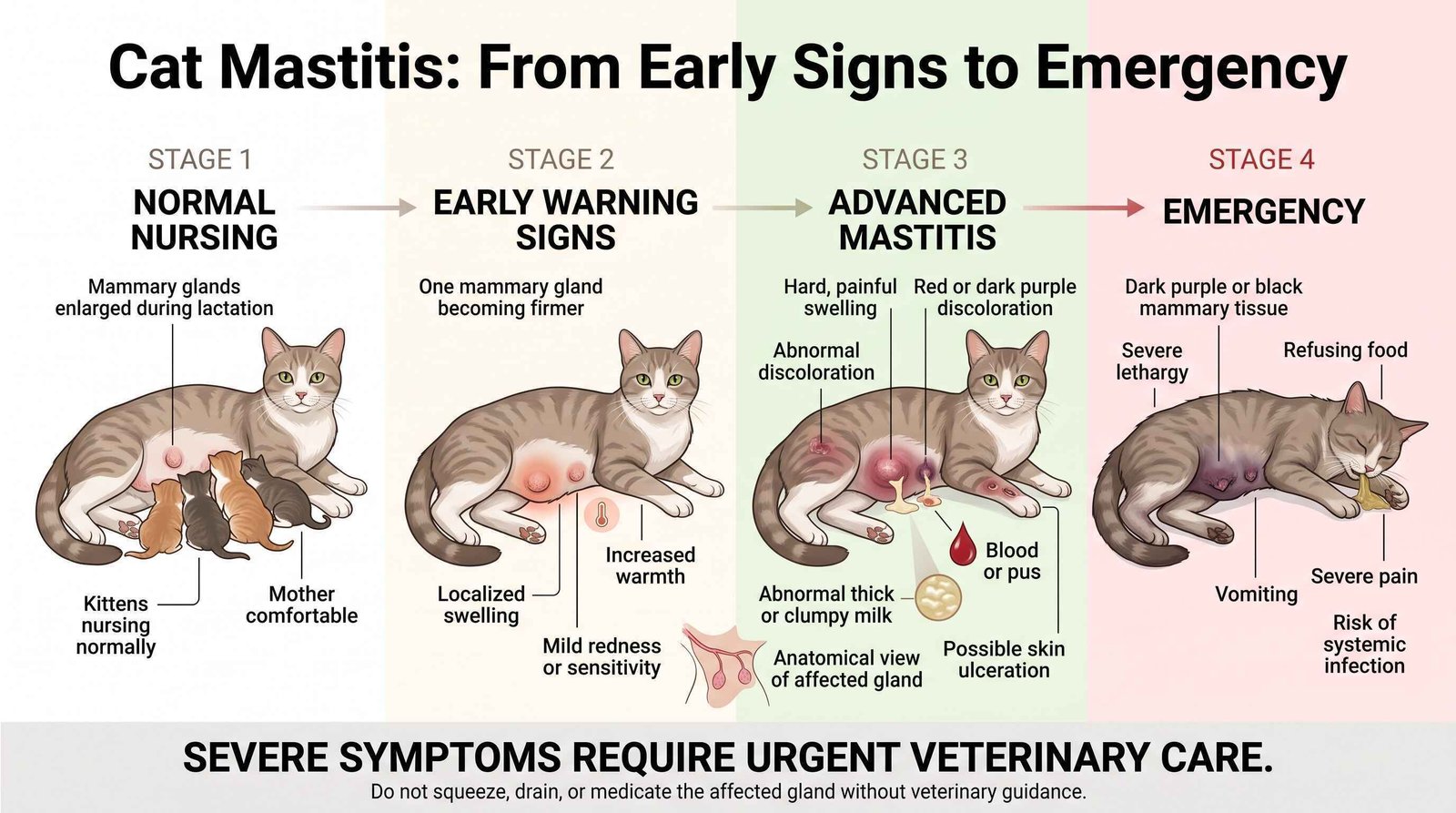
Because the condition can progress rapidly, recognizing the earliest signs of inflammation is vital.
Early Signs of Cat Mastitis
As noted by VCA Animal Hospitals, early mastitis can be subtle. Sometimes, the first clue is not a physical change in the mother, but the fact that her kittens are crying excessively and failing to gain weight normally.
If you examine the mother, early signs may include:
- Slight, localized swelling in one specific gland compared to the others.
- Firmness or hardness around the teat.
- The gland feels noticeably warmer to the touch than surrounding tissue.
- Mild redness or sensitivity when touched.
Signs of More Advanced Mastitis
If the inflammation progresses or a bacterial infection takes hold, the symptoms become much more obvious:
- Significant, hard swelling and intense pain.
- Red or dark purple discoloration of the skin.
- Milk that appears thickened, clumpy, or stringy.
- The presence of blood or pus when milk is expressed.
- Ulceration, scabs, or open wounds on the gland.
Signs of Severe or Potentially Life-Threatening Mastitis
When an infection is severe, it can cause the mammary tissue to die (necrosis) or enter the bloodstream (sepsis). VCA specifically notes that dark purple or black tissue can indicate necrosis. Systemic signs include:
- Extreme lethargy or depression.
- Fever or feeling unusually cold.
- Refusal to eat and vomiting.
- The mother aggressively pushing kittens away due to severe pain.
Why Does a Cat Get Mastitis?
Mastitis rarely happens without a triggering event. The condition is usually caused by bacteria, physical trauma, or disrupted nursing patterns.
Bacterial Infection
The most common cause of septic mastitis is an ascending bacterial infection. Bacteria from the environment, the kittens’ mouths, or the mother’s own skin can enter the mammary gland through the teat canal. Bacteria can also enter through small scratches or abrasions on the nipple.
Milk Stasis and Accumulation
When milk is produced but not removed normally, the gland becomes engorged. This severe accumulation causes painful inflammation. If left unresolved, the stagnant milk can become an ideal breeding ground for a secondary bacterial infection.
Kittens Stopping Nursing Suddenly
Sudden changes in nursing are a major risk factor. VCA specifically identifies sudden weaning and kitten death as circumstances that can result in rapid milk accumulation.
Injuries From Nursing Kittens
As kittens grow, their tiny, sharp claws and developing teeth can cause micro-traumas to the mother’s delicate mammary tissue. These tiny wounds provide a direct pathway for environmental bacteria to invade.
Poor Hygiene
A soiled nesting box provides a heavy bacterial load. While mothers try to keep the area clean, damp bedding significantly increases the risk of an ascending infection.
Can Mastitis Happen in a Cat That Isn’t Nursing?
Yes, though it is less typical. Hormonal situations, such as a “pseudopregnancy” (false pregnancy) in an unspayed female, can trigger milk production. Without nursing kittens, the milk accumulates, potentially leading to mastitis. Other severe mammary conditions can also mimic the signs of mastitis in non-lactating cats.
Can Mastitis Happen During Pregnancy?
While mastitis is overwhelmingly associated with the postpartum period and lactation, owners sometimes notice mammary changes while the cat is still pregnant.
During late pregnancy, it is completely normal for a cat’s mammary glands to enlarge significantly and become pinker as her body prepares to produce milk. Because mammary enlargement can be normal during pregnancy and several mammary conditions can resemble mastitis, unusual swelling, marked pain, discoloration, or illness should be evaluated by a veterinarian rather than treated at home.
What Is Normal for a Nursing Mother Cat?
Before you can identify a problem, it is helpful to know what healthy lactation looks like.
During lactation, it is perfectly normal for a mother cat’s mammary glands to enlarge significantly as they produce and store milk. The mother should generally remain comfortable, attentive to her litter, and have a strong appetite to support her increased caloric needs.
When kittens nurse, the milk should flow easily, and the kittens should exhibit steady, daily weight gain. While the mammary glands will be full, they should remain relatively soft, pliable, and painless to the touch, and the skin should retain its normal color. This natural, healthy enlargement should not be confused with a gland that becomes unusually hot, hard, painfully swollen, discolored, or associated with systemic illness in the mother.
Not Every Swollen Mammary Gland Is Mastitis
It is important to understand that a swollen mammary gland does not automatically mean an infection is present. Potential differential diagnoses include:
- Normal Lactation: Mammary glands naturally enlarge while producing milk.
- Milk Engorgement: A gland can become full and uncomfortable without a bacterial infection.
- Feline Mammary Hyperplasia: This condition, usually driven by hormones, causes rapid, massive, benign enlargement of the mammary tissue. The Merck Veterinary Manual identifies hyperplasia as a condition that can be confused with acute mastitis.
- Mammary Tumors: Hard lumps or masses within the tissue, particularly important to rule out in older cats.
- Trauma: A localized bruise or injury.
Mastitis vs. Other Postpartum Problems in Mother Cats
A person searching for information about a sick nursing mother may mistake one postpartum emergency for another. Merck identifies several distinct postpartum reproductive and lactation-associated disorders:
- Mastitis: Localized or systemic illness stemming from mammary gland inflammation/infection.
- Metritis: A severe bacterial infection of the uterus after giving birth, often causing foul-smelling vaginal discharge, fever, and neglect of the kittens.
- Eclampsia (Milk Fever): A life-threatening drop in blood calcium levels caused by the heavy demands of nursing, leading to restlessness, panting, muscle tremors, and seizures.
A sick postpartum cat may have another emergency, so don’t assume every case of lethargy or fever is mastitis. Veterinary diagnosis is critical.
How Is Cat Mastitis Diagnosed?
You can suspect mastitis based on physical signs, but a definitive diagnosis requires a veterinarian to determine the severity and the correct treatment plan.
- Physical Examination: The veterinarian will assess the cat’s temperature, hydration, and the specific condition of the affected glands.
- Milk Evaluation (Cytology): The veterinarian may examine expressed milk under a microscope to look for signs of inflammation and bacteria.
- Bacterial Culture: A culture and susceptibility test can be highly useful. This tells the veterinarian exactly which bacteria are causing the infection and which antibiotic will be most effective, particularly when infection is severe or doesn’t respond to initial treatment.
- Blood Tests: Used especially when the cat appears systemically ill to assess overall organ function.
- Imaging: Ultrasound may help evaluate abnormal mammary tissue, rule out tumors, or identify deep abscesses.
How Is Mastitis in Cats Treated?
Treatment depends heavily on the severity of the condition and the underlying cause. VCA notes that many cats can be managed with oral medications as outpatients, while severe cases may require hospitalization.
Antibiotics
If a bacterial infection is suspected or confirmed, antibiotics are necessary. When antibiotics are needed, the veterinarian will consider the suspected infection, the mother’s condition, and the safety of any medication for the nursing kittens. Culture and susceptibility testing may guide the choice of medication.
Pain Relief
Mastitis is intensely painful. Pain control encourages the mother to eat and rest comfortably. Never substitute human painkillers, as these are highly toxic to felines.
Supporting Milk Drainage
Veterinarians may recommend controlled milk removal or hand-milking in appropriate cases to help relieve milk accumulation and support drainage. The technique should follow veterinary instructions rather than involve repeated or forceful squeezing of the gland.
Severe Mastitis Treatment
If the cat is systemically ill or sepsis is suspected, she will likely need intravenous (IV) fluids and injectable medications. If an abscess has formed or the mammary tissue has died (necrosis), surgical intervention to lance, drain, or surgically remove the diseased tissue may be required.
Can You Treat Cat Mastitis at Home?
Mastitis should not be treated as a condition that you can safely diagnose and cure at home.
What You Can Do While Waiting for Veterinary Care: Keep bedding clean, keep the mother and kittens comfortable, monitor kitten weight, follow veterinary instructions, and prevent excessive handling of painful glands.
What You Should NOT Do: Do not aggressively squeeze or repeatedly manipulate the gland, do not attempt to drain an abscess or perform invasive treatments, do not give human antibiotics or painkillers, and do not delay veterinary care when systemic symptoms are present.
Can Cat Mastitis Go Away on Its Own?
Some noninfectious inflammation caused by simple milk engorgement may improve when the underlying cause is addressed. However, bacterial mastitis should not be assumed to resolve without treatment. Severe infection can progress rapidly, and waiting is particularly risky when the cat is systemically ill. VCA states that treatment should begin as soon as signs are noticed.
How Long Does Mastitis Last in Cats?
There isn’t one universal timeline for recovery. With prompt diagnosis and appropriate treatment, mild cases commonly resolve within two to three weeks. However, severe cases involving abscesses, tissue necrosis, or systemic illness have a less certain prognosis and will require a longer recovery period.
How Does Mastitis Affect Kittens?
Mastitis can alter the appearance and composition of milk, and the mother’s illness or reduced milk production can interfere with adequate feeding. If the kittens are not nursing effectively or are failing to gain weight, they are at an increased risk of inadequate nutrition.
Can Kittens Nurse From a Cat With Mastitis?
It is not automatically necessary to separate the entire litter. In some cases, continued nursing can help empty the gland, and VCA notes that allowing kittens to nurse from the affected gland may be recommended in some circumstances.
Whether kittens should continue nursing depends on the severity of the infection, the condition of the milk, the mother’s overall condition, and the safety of the medications being used. If nursing is unsafe, painful for the mother, or providing inadequate nutrition, supplementation may be necessary.
What If the Mother Cat Cannot Nurse Her Kittens?
If the mother is hospitalized or the veterinarian advises separating the litter, you must provide supplemental feeding using a commercial Kitten Milk Replacer (KMR). You will need to monitor their weight closely, keep them warm, and follow a strict kitten feeding schedule. For comprehensive guidance on surrogate care, review our article on newborn kitten care. If the kittens begin losing weight or becoming weak, see our guide to fading kitten syndrome for the warning signs that require urgent attention.
Cat Mastitis Complications
Untreated severe mastitis can progress beyond a local mammary problem:
- Abscess: The infection creates a painful pocket of pus that may rupture.
- Tissue Death (Necrosis): Severe infection cuts off the blood supply, causing the tissue to turn dark purple or black and die.
- Severe Infection and Sepsis: Bacteria entering the bloodstream can cause a life-threatening systemic reaction.
- Dehydration and Systemic Illness: Fever, pain, and vomiting can lead to severe organ compromise.
When Is Cat Mastitis an Emergency?
Seek Urgent Veterinary Care If:
- The cat is extremely lethargic or refuses food.
- She has a fever or feels unusually cold.
- She vomits or exhibits severe pain.
- The mother becomes weak, collapses, or seems confused.
- The mammary gland turns dark purple or black.
- There is pus, significant bleeding, or the gland ruptures.
- The kittens are not feeding, are becoming weak, or are failing to gain weight.
How Can Cat Mastitis Be Prevented?
Clean nursing environments and avoiding trauma are recognized preventive considerations.
- Keep the Nesting Area Clean: Change soiled bedding frequently to minimize environmental bacteria.
- Check the Mammary Glands Regularly: Inspect the mother’s glands daily for redness or abnormal swelling.
- Keep Kittens’ Claws Appropriately Trimmed: Gently trimming the tips of the kittens’ claws can prevent them from scratching the mother’s delicate tissue.
- Monitor Nursing and Kitten Weight: Ensure kittens are nursing evenly to prevent severe engorgement in a single gland.
- Manage Sudden Weaning Carefully: If kittens must be weaned suddenly, seek veterinary advice on managing the mother’s milk production safely.
- Seek Veterinary Care for Wounds: Address any abnormal mammary changes or injuries promptly.
Cat Mastitis in Feral and Outdoor Cats
Discovering a feral cat with suspected mastitis is challenging. Because they are unsocialized, observing early signs is difficult, and the cat may hide if she is in pain.
Do not attempt risky handling of a painful, unsocialized cat using bare hands. Instead, contact a local trap-neuter-return (TNR) group or animal rescue organization. They have the equipment to safely trap the mother (and her kittens) for secure transport to a veterinary clinic where she can be treated appropriately.
Frequently Asked Questions About Cat Mastitis
Can cat mastitis go away on its own?
Some noninfectious inflammation may improve when the underlying cause is addressed, but bacterial mastitis should not be assumed to resolve without treatment. Severe infection can progress rapidly, and waiting is particularly risky when the cat is systemically ill.
What are the first signs of mastitis in cats?
Early signs can be subtle. They include slight localized swelling, firmness, abnormal warmth, mild redness, or sensitivity in a mammary gland. Sometimes, the first clue is that the kittens are crying excessively and failing to gain weight.
How quickly should a cat with mastitis see a vet?
A cat showing signs of mastitis should be evaluated by a veterinarian promptly. If the cat is lethargic, vomiting, refusing food, or if the tissue turns dark purple or black, it is an immediate medical emergency.
What antibiotic is used for cat mastitis?
Veterinarians choose antibiotics based on the suspected infection, the mother’s condition, and the safety of the medication for the nursing kittens. Culture and susceptibility testing may be recommended to guide the specific choice.
Can a cat with mastitis still nurse her kittens?
It is not automatically necessary to separate the litter. In some cases, continued nursing can help empty the gland. Whether kittens should nurse depends on the severity of the infection, the condition of the milk, and veterinary guidance.
Can kittens get sick from a mother’s mastitis?
Mastitis can alter the appearance and composition of milk, and the mother’s illness or reduced milk production can interfere with adequate feeding, increasing the risk of inadequate nutrition for the kittens.
How long does cat mastitis take to heal?
With appropriate treatment, mild cases commonly resolve within two to three weeks. However, severe cases involving abscesses or systemic illness have a less certain prognosis and may require a longer recovery period.
Can a cat get mastitis without being pregnant?
Yes, though it is less typical. Hormonal situations, such as a “false pregnancy,” can trigger milk production. Without nursing kittens, the milk accumulates, potentially leading to mastitis.
Can mastitis affect only one mammary gland?
Yes. Mastitis can affect a single mammary gland, or it can affect multiple glands simultaneously.
Can mastitis happen after kittens are weaned?
Yes. Sudden reduction in nursing or abrupt weaning can cause rapid milk accumulation and engorgement, which can contribute to the development of mastitis.
What does severe mastitis look like?
Severe mastitis involves significant, hard swelling, intense pain, and abnormal milk containing blood or pus. The skin may become ulcerated or turn dark purple/black, indicating tissue necrosis. The cat is often lethargic, feverish, and refusing food.
Key Takeaways
- Mastitis is inflammation of one or more mammary glands.
- It commonly occurs around lactation and the postpartum period.
- Early signs can be subtle, including firm, warm swelling and poor kitten weight gain.
- Abnormal milk, painful swelling, and discoloration require prompt veterinary attention.
- Severe cases can cause abscesses, tissue death, and systemic infection.
- Kittens should be monitored closely for adequate feeding and weight gain.
- Do not attempt to aggressively squeeze, drain, or medicate the cat yourself.