
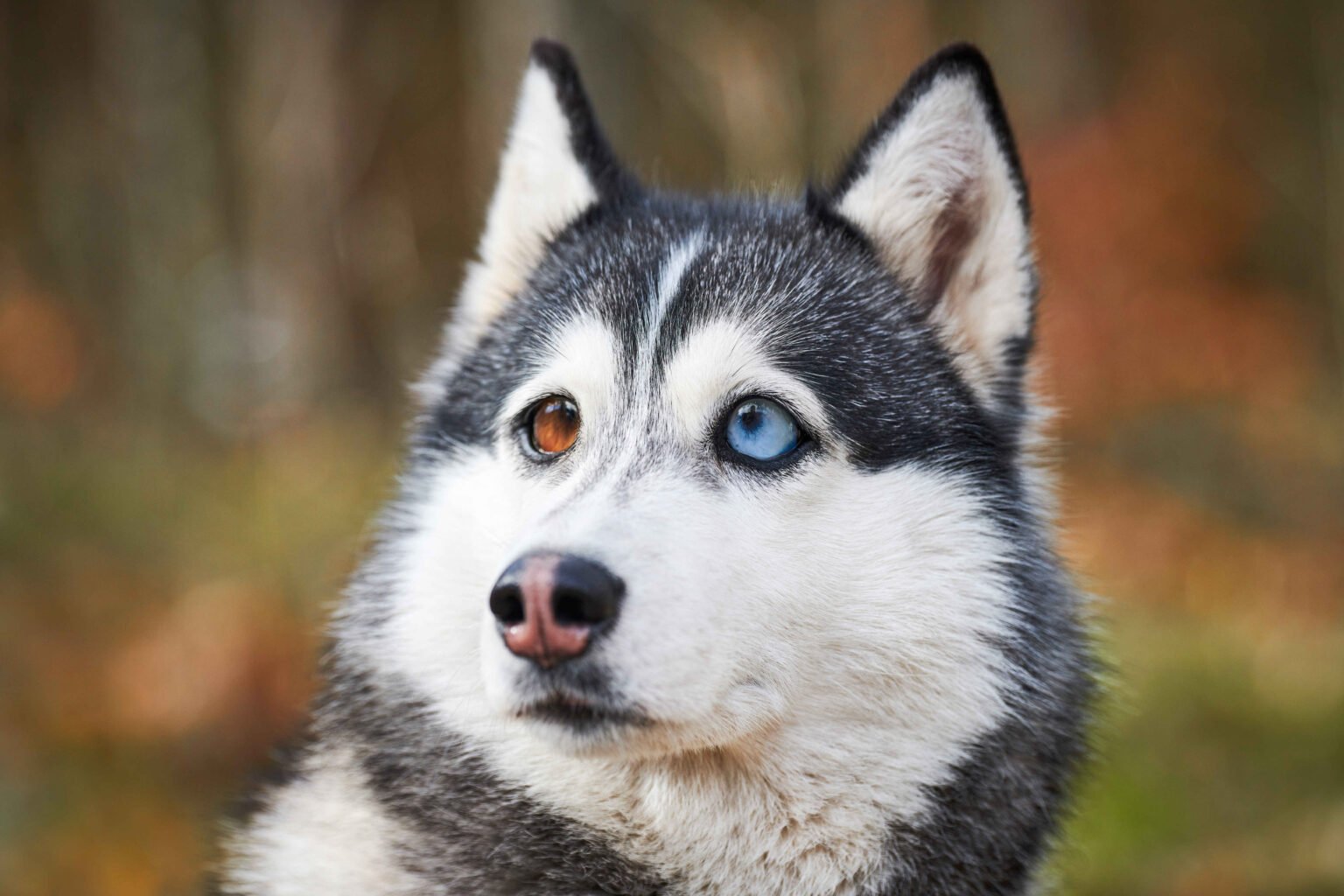
If you have a young Siberian Husky with striking blue or gray-blue eyes, you may be wondering whether that color is permanent. When do Husky puppies’ eyes change color? The answer is that changes can occur during puppyhood, but the timing varies from one puppy to another.
A veterinarian answering a Husky-specific question notes that if a puppy’s eye color changes, it will usually happen by around 12–16 weeks of age, although predicting the exact final color can be difficult.
Some Huskies keep blue eyes throughout their entire lives. Others develop brown eyes, while some have one blue and one brown eye or a mixture of colors within an individual eye. The official Siberian Husky breed standard specifically recognizes brown, blue, one of each, and parti-colored eyes as perfectly normal and acceptable.
Quick Answer: When Do Husky Puppies’ Eyes Change Color?
Husky puppies’ eye color can develop and change during the first few months of life, but the timing varies between individuals. By around 12–16 weeks of age, the developing eye color is generally much easier to judge and is often close to the adult color. Some Huskies keep blue eyes throughout their lives, while others develop brown, one-blue-and-one-brown, or parti-colored eyes.
A very young puppy’s eyes may look blue, gray-blue, or darker than expected. As the iris develops and pigmentation becomes more apparent, the eyes may remain blue or become brown or another recognized Husky eye pattern.
There is no single week at which every Husky puppy’s eye color becomes permanent.
Do Husky Puppies’ Eyes Change Color?
Yes, some do.
A Husky puppy’s eye color during the early weeks of life does not always tell you exactly what the adult eye color will be. Changes can be subtle or gradual. For example, a puppy may initially appear to have hazy gray-blue eyes and later develop a much deeper, icy blue appearance, or gradually develop more visible brown pigmentation.
Some puppies retain blue eyes as they mature, without developing a different adult eye color. It is important not to assume that every blue-eyed Husky puppy will eventually develop brown eyes.
Blue is a normal and recognized adult eye color for the Siberian Husky, and the breed standard fully allows blue eyes in adult dogs. This is important when interpreting a puppy’s eye color. A blue-eyed Husky puppy is not necessarily an unfinished version of a brown-eyed adult. Blue can be the adult color itself.
When Do Husky Puppies’ Eyes Change Color?
There is no scientifically established, week-by-week timetable that applies universally to every single Siberian Husky. Eye development occurs gradually, and the timing of visible color changes can vary between puppies.
The following timeline should therefore be treated as a general guide rather than a set of deadlines.
| Puppy Age | What You May Notice |
|---|---|
| Birth–2 weeks | Eyes remain closed during early development. |
| Around 2–3 weeks | Eyes begin opening; vision is still developing. |
| 3–8 weeks | Eye appearance may gradually develop. |
| 8–12 weeks | Developing eye color may become easier to judge. |
| 12–16 weeks | The developing eye color is generally much easier to judge. |
Important: These are approximate developmental ranges, not fixed deadlines. Individual Husky puppies can mature at different rates.
Birth to about 2 weeks
Newborn puppies have their eyes closed. Eye opening occurs during the second or third week of life, so there is no meaningful way to predict adult eye color immediately after birth.
Around 2–3 weeks
Husky puppies begin opening their eyes during this period. Their vision is still immature, so the appearance of the eyes at this age should not be considered a reliable indication of the final adult color. Eye opening is a developmental milestone, not the point at which adult eye color is established.
About 3–8 weeks
As the puppy grows, the appearance of the iris can gradually develop. Some owners may notice changes in shade or pigmentation during this period, while others may see very little difference.
About 8–12 weeks
By this stage, the developing eye color may be easier to judge, but it is still not necessarily the final adult color. A blue-eyed puppy may remain blue, while another puppy may develop more visible pigmentation.
Around 12–16 weeks
This is the most useful general age range for judging a Husky puppy’s developing adult eye color. Some individual dogs may show subtle changes after this period, so 16 weeks should not be treated as an absolute biological cutoff.
When Do Husky Puppies’ Eyes Stop Changing Color?
Most Husky puppies’ eye color is much easier to judge by around 12–16 weeks of age. This does not mean that every puppy’s eyes become permanently fixed at exactly 16 weeks.
Some dogs may show subtle differences in shade or pigmentation after this period. The most useful distinction is between a gradual developmental change during puppyhood and a sudden change in an adult dog’s eye.
If your four-month-old Husky still has blue eyes, that is not unusual. Blue is a recognized and normal adult eye color for the Siberian Husky.
Will My Husky Puppy’s Eyes Stay Blue?
They may. Blue eyes are a normal adult characteristic of the Siberian Husky, so a blue-eyed puppy does not necessarily need to develop brown eyes.
A young puppy’s blue eyes can remain blue as the dog matures. However, a very young puppy’s eye color cannot guarantee the final adult appearance.
If the eyes remain clearly blue as the puppy approaches four months of age, that provides more useful information than the eye color seen during the first few weeks. Even then, individual development varies. The important point is that blue eyes in a Husky are not automatically a temporary puppy stage.
What If My Husky Puppy’s Eyes Are Still Blue at 4 Months?
If your Husky puppy is around four months old and still has blue eyes, there is no reason to assume that something is wrong simply because the color has not changed.
Blue is an accepted adult eye color in the Siberian Husky, so some puppies retain blue eyes as they mature. The absence of a color change is therefore just as normal as a gradual change toward another recognized eye color.
What matters more is whether the eye looks healthy. An eye that has remained blue throughout puppyhood is different from an adult dog’s eye that suddenly develops cloudiness, a gray appearance, or another noticeable change.
What About Gray-Looking Eyes?
Young puppies’ eyes can sometimes appear gray-blue rather than clearly blue. Lighting, the amount of visible pigmentation, and the developing appearance of the iris can make the color difficult to classify precisely.
For that reason, owners should not feel that they need to assign an exact color to a very young puppy. The more useful question is whether the eye is developing normally and what color it becomes as the puppy matures.
Why Do Husky Puppies’ Eyes Change Color?
Eye color is influenced by pigmentation within the iris and genetics. Blue eyes are associated with relatively little pigment in the iris, while differences in pigmentation contribute to darker eye colors.
As a puppy matures, changes in the amount and distribution of pigmentation can alter the way the iris appears. Genetics influence the amount of pigmentation that develops and therefore contribute to the adult eye color or pattern.
This is why it is too simplistic to say that all Husky puppies are born with blue eyes and then “turn brown” as they produce more melanin. Some Huskies retain blue eyes throughout adulthood, while others develop brown or other recognized eye patterns.
What Role Does Genetics Play in Husky Eye Color?
Genetics play an important role in Siberian Husky eye color, and research has identified a particularly interesting genetic association.
A 2018 study published in PLOS Genetics identified a 98.6-kilobase DNA duplication near the ALX4 gene on chromosome 18 that was strongly associated with blue eyes and heterochromia in Siberian Huskies.
However, the association is not absolute. The researchers found that some brown-eyed dogs also carried the variant, showing that the relationship between genetics and visible eye color is more complex than a simple single-gene explanation.
The ALX4-associated variant is therefore an important genetic clue, but it cannot guarantee a particular puppy’s adult eye color. Likewise, the visible eye colors of the parents cannot reliably predict the puppy’s final eye color on their own.
This is why a puppy’s final eye color cannot be predicted reliably from the visible eye colors of its parents alone. Genetic inheritance is more complex than a straightforward brown-versus-blue pattern, and research has identified genetic variants associated with blue eyes without making them an absolute predictor.
What Eye Colors Can Siberian Huskies Have?
Siberian Huskies are unusual among dog breeds because several eye-color patterns are recognized as normal within the breed. If you are interested in learning more about the breed’s incredible diversity, check out our guide to 22 + 1 Types of Husky Breeds.
Blue eyes
Blue is one of the most recognizable Husky eye colors. Adult Huskies can retain blue eyes, so a blue-eyed puppy does not automatically need to develop another color.
Brown eyes
Brown eyes are also normal in Siberian Huskies. A brown-eyed Husky is not considered unusual simply because the breed is famous for its blue eyes.
One blue eye and one brown eye
Some Huskies have one blue eye and one brown eye. This is commonly described as complete heterochromia. The Siberian Husky breed standard recognizes “one of each” eye color.
Parti-colored eyes
A single eye can also contain more than one color. These are described as parti-colored eyes, which are also recognized by the breed standard.
These patterns are part of normal variation in the breed and should not automatically be interpreted as signs of disease.
Can You Predict a Husky Puppy’s Adult Eye Color?
You can make an educated guess, but you cannot reliably guarantee the adult eye color of a very young Husky puppy.
The puppy’s current eye color provides some information, but genetics, development, and pigmentation all contribute to the final appearance. A very young puppy is therefore much harder to assess than a puppy approaching four months of age.
If you want to track the change yourself, take photographs of your puppy’s eyes every few weeks under similar lighting. Comparing photographs taken under consistent conditions is more useful than comparing a brightly lit outdoor photograph with a dim indoor photograph.
Puppy Eye Color vs. Adult Eye Color: What Can You Actually Tell?
When trying to decipher your Husky’s future appearance, it helps to understand what different stages actually reveal:
- Very young puppy: It can be difficult to predict the final eye color because the eyes are still developing.
- 8–12 weeks: The eyes become more informative. Pigmentation is settling, giving you a stronger hint, but it is not yet definitive.
- 12–16 weeks: The developing eye color is much easier to judge.
- Blue at four months: A Husky with bright blue eyes at 16 weeks may retain that blue eye color into adulthood.
- Genetics provide clues but not certainty: Parents’ eye colors can provide clues, but they cannot by themselves guarantee a puppy’s adult eye color.
Why Your Husky’s Eyes May Look Different in Photos
Owners often panic, thinking their puppy’s eyes have radically changed color overnight, only to realize the difference was caused by the camera. Several factors influence how an eye appears in a picture:
- Lighting: Natural and indoor light can make the same eye appear substantially different.
- Camera exposure: Overexposure can wash out light colors.
- Reflections: Reflected light and surrounding colors can alter how the eye appears in a photograph.
- Pupil size: A larger pupil can make the iris appear less prominent.
- Background: Surrounding colors can influence how we perceive the eye.
For the most useful comparison, photograph your puppy’s eyes under similar lighting and from a similar angle every few weeks.
When Should an Eye-Color Change Be Checked by a Veterinarian?
Normal developmental changes during puppyhood are generally gradual. A sudden or persistent change in an adult dog’s eye—especially when accompanied by pain, redness, cloudiness, discharge, squinting, or vision changes—should be evaluated by a veterinarian rather than assumed to be normal pigmentation.
If you are unsure whether a color difference is normal pigmentation or a medical change, a veterinarian can examine the eye directly and ensure there are no underlying health issues.
Key Takeaways
- Husky puppies do not all follow the same eye-color timeline.
- Eye development begins after the eyes open during the first few weeks of life.
- Around 12–16 weeks is a useful general benchmark for judging the developing adult eye color.
- Some Huskies retain blue eyes throughout adulthood.
- Brown eyes, blue eyes, one blue and one brown eye, and parti-colored eyes are all recognized in Siberian Huskies.
- Genetics influence eye color, including a genetic variant near ALX4 that is strongly associated with blue eyes in the breed.
- A puppy’s eye color and its parents’ eye colors cannot guarantee the final adult color.
- A sudden eye change in an adult Husky, especially when accompanied by pain, redness, or cloudiness, should be evaluated by a veterinarian.
Frequently Asked Questions
Do Husky puppies’ eyes change color?
Some do, and some do not. A Husky puppy’s eye appearance can change as the iris develops, but many Huskies retain blue eyes into adulthood.
What age do Husky puppies’ eyes change color?
Changes can become noticeable during the first few months, but there is no exact age that applies to every puppy. Around 12–16 weeks is a useful general benchmark for when the developing adult color becomes easier to judge.
When do Husky puppies’ eyes stop changing color?
Most major developmental changes are much easier to assess by around 12–16 weeks, although subtle differences can occur later. There is no exact age at which every Husky’s eye color becomes permanently fixed.
Will my Husky puppy’s eyes stay blue?
They may. Blue is a normal adult eye color for Siberian Huskies. A blue-eyed puppy can remain blue-eyed into adulthood.
Can a Husky have two different colored eyes?
Yes. Siberian Huskies can have one blue eye and one brown eye. This is commonly called complete heterochromia and is recognized by the breed standard.
Can one Husky eye have more than one color?
Yes. Parti-colored eyes are also recognized in Siberian Huskies. A single iris can contain more than one visible color.
Is it normal for an adult Husky’s eye color to suddenly change?
A sudden persistent change should not automatically be considered normal pigmentation. If it occurs with cloudiness, redness, pain, discharge, squinting, or vision changes, your dog should be examined by a veterinarian.