


The early signs of arthritis in dogs are often subtle. A dog may take longer to get up after resting, hesitate before stairs or jumping, walk more slowly, avoid previously enjoyable activities, or become less willing to play. Some dogs also show behavioral changes because chronic joint pain affects how they move and interact.
- Quick Answer: What Are the Early Signs of Arthritis in Dogs?
- 5 Early Signs Dog Owners Usually Notice First
- 12 Early Signs of Arthritis in Dogs
- 1. Taking Longer to Get Up After Rest
- 2. Stiffness That Improves With Movement
- 3. Hesitation or “Bunny Hopping” on Stairs
- 4. Reluctance to Jump
- 5. Walking More Slowly
- 6. Reduced Enthusiasm for Play
- 7. Intermittent or Subtle Limping
- 8. Changing Positions Frequently While Resting
- 9. Muscle Loss (Atrophy)
- 10. Behavioral Changes and Irritability
- 11. Altered Posture or Weight Shifting
- 12. Changes in Grooming Habits
- How Arthritis Can Look Different in Dogs
- How to Tell Arthritis From Normal Aging
- Can a Dog Have Arthritis Without Limping?
- At What Age Do Dogs Get Arthritis?
- What Causes Arthritis in Dogs?
- How to Tell if Your Dog Is in Pain
- How Vets Diagnose Arthritis
- When Should You Take Your Dog to the Vet?
- What Can You Do for a Dog With Arthritis?
- How to Help Your Dog With Arthritis at Home
- Exercise and Arthritis
- Weight, Diet and Supplements
- Can Arthritis Be Prevented?
- What Does Advanced Arthritis Look Like?
- Frequently Asked Questions About Arthritis in Dogs
- Can arthritis cause a dog to sleep more?
- Can arthritis make a dog suddenly aggressive?
- Can a dog have arthritis without limping?
- Can arthritis affect a dog’s back legs?
- Does arthritis get worse after exercise?
- How can I tell arthritis pain from normal aging?
- Should I walk a dog showing early signs of arthritis?
- Final Takeaway
- References & Further Reading
Arthritis isn’t simply an “old dog problem.” Osteoarthritis can begin much earlier, particularly in dogs with previous joint injuries, developmental joint abnormalities, excess weight, or inherited orthopedic problems.
Take Action: If you have noticed two or more of these mobility or behavioral changes, record what you are seeing and discuss it with your veterinarian rather than assuming your dog is simply “getting older.”
Quick Answer: What Are the Early Signs of Arthritis in Dogs?
The earliest indicators of canine osteoarthritis are usually shifts in a dog’s daily routines and mobility. Rather than crying out in obvious pain, an arthritic dog will alter their biomechanics to protect sore joints. This often presents as stiffness after sleep, taking a few extra seconds to stand, hesitating at the bottom of a staircase, or losing the enthusiasm to jump onto furniture.
5 Early Signs Dog Owners Usually Notice First
Before a dog develops a severe limp, owners typically notice these five hallmark changes in behavior and movement:
- Stiffness after sleeping: The dog appears rigid or awkward for the first few steps after waking up.
- Taking longer to get up: A struggle to push off the floor, often relying heavily on the front legs.
- Hesitating on stairs: Pausing before climbing or descending, or attempting to “bunny hop” to avoid flexing individual joints.
- Avoiding jumping: Pacing in front of a bed or car, putting the front paws up, but waiting to be lifted.
- Walking or playing less: Lagging behind on walks, stopping to sniff excessively to rest, or losing interest in games of fetch.
12 Early Signs of Arthritis in Dogs
To recognize arthritis early, you have to know exactly what to look for. Here are 12 specific symptoms, what they look like, when they happen, and why they matter.
1. Taking Longer to Get Up After Rest
- What it looks like: Your dog may take several seconds to stand, shift weight between the hind legs, or stretch repeatedly before walking normally.
- When owners notice it: Most commonly in the morning or after a long daytime nap.
- Why it matters: Resting allows fluid in an arthritic joint to thicken and inflammatory mediators to pool, making the initial movement painful and difficult.
2. Stiffness That Improves With Movement
- What it looks like: The dog walks with a rigid, unbending gait for a few minutes but seems to loosen up and walk more normally afterward.
- When owners notice it: Usually right after the dog finally gets up from sleeping.
- Why it matters: This “warming out” of stiffness is a classic hallmark of early osteoarthritis. The joint fluid becomes less viscous as the dog begins moving.
3. Hesitation or “Bunny Hopping” on Stairs
- What it looks like: The dog stops at the bottom or top of a staircase, or goes up by bringing both back feet forward at the same time (a bunny hop).
- When owners notice it: During daily routines that require ascending or descending steps.
- Why it matters: Stairs force a dog to bear significant weight on individual flexed joints. Bunny hopping is a mechanical adaptation to avoid that targeted pressure.
4. Reluctance to Jump
- What it looks like: A dog that previously leapt onto the couch or into an SUV now paces, whines, or only puts their front paws up.
- When owners notice it: Getting into vehicles, getting onto furniture, or navigating trail obstacles.
- Why it matters: Jumping requires explosive power from the hind legs and heavy impact absorption on the front legs, both of which are painful with arthritis.
5. Walking More Slowly
- What it looks like: The dog falls behind your normal walking pace, stops frequently, or seems eager to turn back toward home.
- When owners notice it: During daily neighborhood walks.
- Why it matters: Reduced pace is often interpreted as a dog “calming down” with age, but it frequently indicates that maintaining a brisk walk hurts.
6. Reduced Enthusiasm for Play
- What it looks like: The dog no longer brings toys to you, stops chasing balls after one or two throws, or declines to wrestle with other dogs.
- When owners notice it: During park visits or backyard play sessions.
- Why it matters: Dogs are highly motivated by play; losing interest in it is a strong indicator that the physical cost (pain) has outweighed the psychological reward.
7. Intermittent or Subtle Limping
- What it looks like: A slight head bob when walking, a shortened stride on one side, or a limp that comes and goes depending on the day.
- When owners notice it: After heavier exercise, in cold/damp weather, or uneven terrain.
- Why it matters: Limping is the physical manifestation of a dog trying to unweight a painful limb.
8. Changing Positions Frequently While Resting
- What it looks like: The dog lies down, sighs, gets up, circles, and lies down again in a different position, or sleeps with legs splayed awkwardly.
- When owners notice it: In the evening when the dog is trying to settle.
- Why it matters: An arthritic joint aches even at rest. The dog is struggling to find a position that relieves the pressure.
9. Muscle Loss (Atrophy)
- What it looks like: One leg, or the hindquarters generally, looks visibly thinner or feels less substantial than the rest of the body.
- When owners notice it: While petting the dog or looking at them from behind.
- Why it matters: When a joint hurts, a dog uses it less. This “disuse” causes the supporting muscles to shrink rapidly.
10. Behavioral Changes and Irritability
- What it looks like: A normally sweet dog growls when touched, avoids being petted, or is less tolerant of children or other pets.
- When owners notice it: During grooming, petting, or when another animal bumps into them.
- Why it matters: Chronic pain depletes a dog’s tolerance. They become protective of their sore body.
11. Altered Posture or Weight Shifting
- What it looks like: Standing with a hunched back, tucking the pelvis under, or shifting weight predominantly onto the front legs.
- When owners notice it: When the dog is standing still, eating, or drinking.
- Why it matters: Postural shifts are a dog’s attempt to redistribute their body weight away from painful joints (like the hips) and onto healthier ones (like the shoulders).
12. Changes in Grooming Habits
- What it looks like: The dog constantly licks a specific joint (like the wrist/carpus), or fails to groom their hind end because turning is too painful.
- When owners notice it: Evening quiet time, or noticing saliva-stained fur over a joint.
- Why it matters: Licking is a common canine response to localized pain or aching. Conversely, a lack of grooming indicates spinal or hip stiffness preventing normal flexibility.
How Arthritis Can Look Different in Dogs
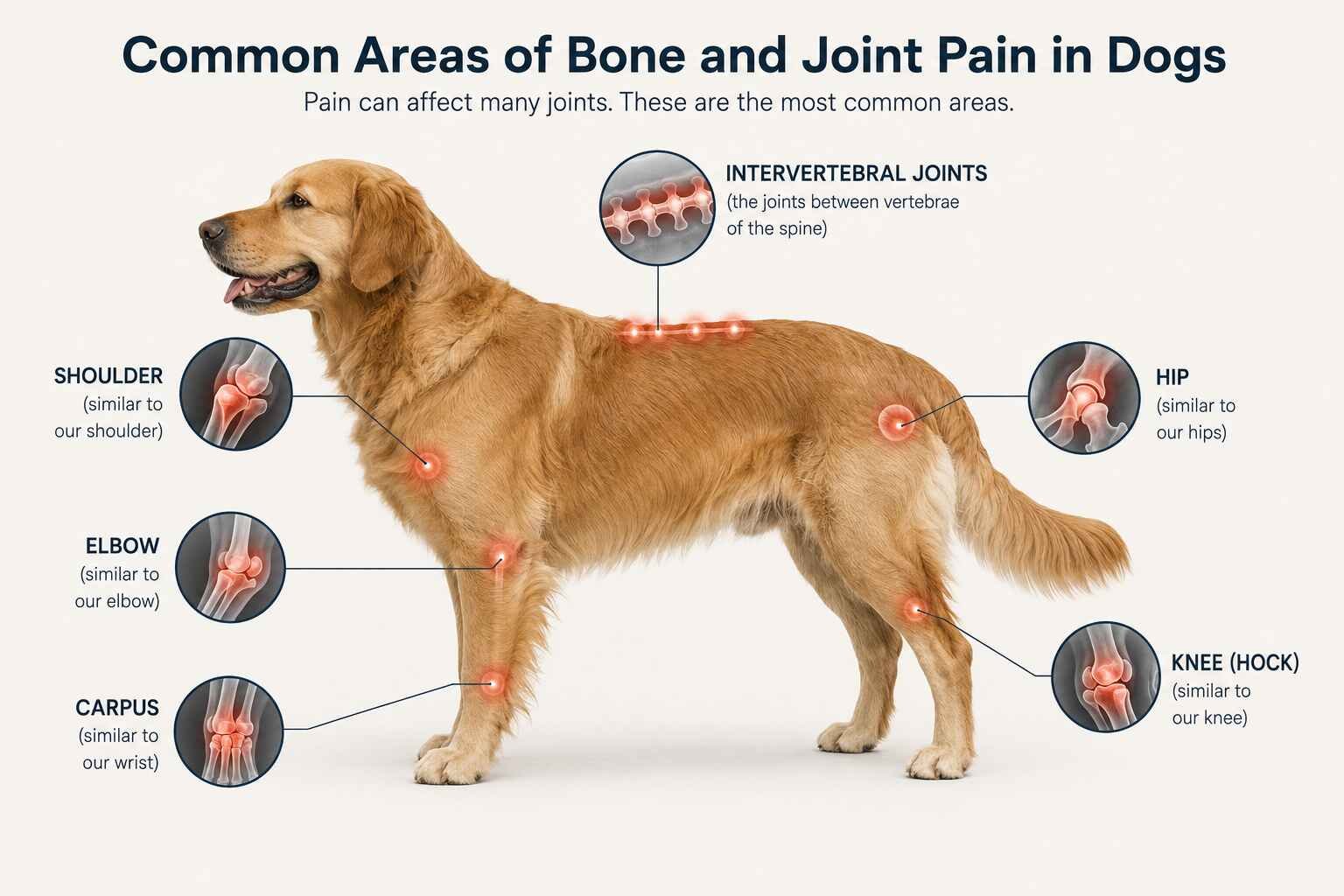
Arthritis doesn’t look identical in every dog. The symptoms heavily depend on which joints are affected.
Hind legs
Arthritis in the back legs often presents as weakness. The dog may “bunny hop” up stairs, struggle to stand from a seated position, and lose muscle mass in the thighs.
Front legs
Because dogs carry about 60% of their body weight on their front legs, arthritis here often causes a visible head bob. The dog will throw their head up when the painful front paw strikes the ground to reduce the weight load.
Hips
Hip arthritis (often stemming from hip dysplasia) causes a swaying, stiff-hipped gait. The dog may have difficulty rising and may sit awkwardly, kicking one or both back legs out to the side.
Elbows
Elbow arthritis frequently causes the dog to take short, stiff front steps. They may stand with their front paws turned outward or paddle their front legs when walking.
Multiple joints
If arthritis is widespread, the dog may not show a specific limp. Instead, they will have a generalized, stiff, shuffling walk and seem universally reluctant to move.
How to Tell Arthritis From Normal Aging
It is easy to dismiss early arthritis signs by saying, “He’s just getting old.” But aging itself is not a disease. Normal senior dogs may have slightly less stamina, but they should not be in pain.
| Normal Aging | Possible Arthritis |
|---|---|
| Slightly less stamina on long hikes | Refuses normal daily walks; lags behind quickly |
| Sleeps a bit deeper or longer | Struggles, groans, or takes several seconds to stand |
| Moves a bit slower but fluidly | Moves with obvious stiffness or “bunny hops” |
| Still manages stairs safely | Hesitates, slips, or refuses stairs entirely |
Can a Dog Have Arthritis Without Limping?
Yes. This is one of the most common misconceptions. If a dog has arthritis in both hips or both elbows (bilateral disease), they will not have a “good” leg to favor. Therefore, they won’t show an uneven limp. Instead, they will shift their weight, alter their posture, and develop a short, stiff, shuffling gait to minimize impact across all affected joints.
At What Age Do Dogs Get Arthritis?
There is no single age when dogs develop arthritis. Risk increases with age, but young dogs can also develop osteoarthritis because of hip or elbow dysplasia, previous joint injuries, abnormal joint development, or other orthopedic problems.
Young dogs
Arthritis in young dogs is usually “secondary osteoarthritis,” meaning it develops quickly due to a structural problem (like severe hip dysplasia) or trauma (like a torn cruciate ligament).
Middle-aged dogs
This is often the period when the cumulative effect of minor joint abnormalities or highly active lifestyles begins to cause visible symptoms. A dog might have had mild dysplasia for years, but the stiffness only becomes apparent to the owner at age five or six.
Senior dogs
While age brings cumulative wear and tear to the cartilage, old age itself is a risk factor, not a diagnosis. A senior dog with mobility issues should be evaluated for arthritis rather than assuming nothing can be done.
What Causes Arthritis in Dogs?
Canine osteoarthritis is a progressive disease involving the breakdown of cartilage, inflammation, and the formation of new bone (osteophytes) around the joint. It is rarely just “wear and tear.” Common causes include:
- Developmental orthopedic diseases: Hip dysplasia, elbow dysplasia, and osteochondritis dissecans (OCD).
- Joint injuries: Cranial cruciate ligament (CCL) tears or fractures that involve the joint.
- Obesity: Excess weight places massive mechanical stress on joints and actively promotes systemic inflammation.
- Genetics: Certain large and giant breeds are highly predisposed.
- Repetitive stress: Lifetimes of heavy impact from sports or working activities.
How to Tell if Your Dog Is in Pain
Because dogs are stoic pack animals, they mask pain to avoid showing vulnerability. Look for these subtle indicators of discomfort:
- Excessive licking or chewing of a specific joint (like the wrist).
- Panting heavily when resting or not hot.
- Trembling or muscle twitching in the legs.
- Flinching, pulling away, or growling when brushed or petted over the hips or spine.
- A glazed or dull look in their eyes.
How Vets Diagnose Arthritis
A veterinarian will use several tools to diagnose osteoarthritis and evaluate its severity.
Medical history and observation
The vet will ask about changes in your dog’s daily routines. Providing home videos of your dog getting up or walking is incredibly helpful, as dogs often mask their stiffness when filled with adrenaline at the clinic.
Physical and orthopedic examination
The vet will watch the dog walk (gait analysis) and physically manipulate the joints, checking for swelling, reduced range of motion, pain responses, and crepitus (a grinding sensation).
X-rays (Radiographs)
X-rays reveal bone remodeling, spurs, and joint fluid changes. However, X-rays and clinical signs do not always match perfectly. A dog with terrible X-rays might cope well, while a dog with mild X-ray changes might be in severe pain. Treatment is always tailored to the dog’s clinical comfort, not just the image.
When Should You Take Your Dog to the Vet?
Use this decision framework to determine when to seek veterinary care.
Make an appointment if:
- Stiffness keeps returning or is becoming more frequent.
- Mobility is noticeably declining over weeks or months.
- Your dog stops engaging in activities they previously enjoyed.
- Limping persists or recurs intermittently.
- Stairs or jumping have become a visible struggle.
Seek urgent veterinary care if:
- Sudden, severe lameness (the dog refuses to bear any weight on a leg).
- Inability to stand or walk.
- Obvious severe pain, crying out, or distress.
- Rapidly developing swelling around a joint.
- Sudden neurological abnormalities (dragging feet, knuckling, or loss of balance).
What Can You Do for a Dog With Arthritis?
There is no single “cure” for osteoarthritis. The most effective approach is a multimodal management plan tailored to your dog.
Veterinary pain management
Veterinarians frequently prescribe dog-specific Non-Steroidal Anti-Inflammatory Drugs (NSAIDs) or other analgesics to control pain and reduce inflammation.
Important: Do not give your dog human pain medication unless a veterinarian specifically tells you to do so. Some human medications, including ibuprofen and acetaminophen, can cause serious or potentially life-threatening poisoning in dogs.
Established management approaches
Beyond medication, vets emphasize weight optimization and controlled exercise to manage the disease long-term.
Interventions that may help some dogs
Depending on the case, a vet might recommend physical rehabilitation, hydrotherapy, acupuncture, or joint injections.
How to Help Your Dog With Arthritis at Home
Simple environmental modifications make a massive difference in your dog’s daily comfort.
- Floor traction: Put down non-slip rugs or yoga mats over slippery hardwood or tile floors to prevent painful slips and falls.
- Ramps and steps: Use portable ramps for the car and pet stairs for the bed or couch to eliminate the impact of jumping.
- Supportive bedding: Provide a thick, orthopedic foam bed in a warm, draft-free area to support aching joints.
- Elevated bowls: Raise food and water dishes to elbow height to reduce strain on the neck and front legs.
Exercise and Arthritis
Arthritic dogs still need to move; stopping exercise entirely causes muscle wasting and worsening stiffness. The key is controlled, low-impact exercise.
Instead of one exhausting hour-long run on Saturday, aim for multiple short, consistent 15-minute walks on flat surfaces every day. Avoid high-impact activities like throwing a frisbee or ball, which require sudden stops, jumping, and twisting.
Weight, Diet and Supplements
Weight control is critical. Lean dogs experience significantly less joint pain and inflammation than overweight dogs. If your arthritic dog is heavy, safely losing weight under veterinary guidance is often the single most impactful treatment.
Veterinarians often incorporate Omega-3 fatty acids (EPA and DHA) into arthritis management plans due to their anti-inflammatory properties. Other joint supplements, like glucosamine and chondroitin, are widely used, though evidence regarding their clinical effectiveness varies. Always consult your vet before starting a supplement regimen to ensure safety and proper dosing.
Can Arthritis Be Prevented?
You cannot prevent every case of arthritis, but risk can sometimes be reduced through:
- Maintaining a healthy, lean body condition from puppyhood through the senior years.
- Providing appropriate exercise and avoiding extreme, repetitive joint stress in young, growing puppies.
- Preventing or appropriately managing joint injuries (like surgically repairing a torn cruciate ligament promptly).
- Responsible breeding practices and health screening to reduce inherited orthopedic conditions.
What Does Advanced Arthritis Look Like?
As osteoarthritis progresses to an advanced stage, the signs become severely restrictive. A dog may have significant difficulty standing up on their own, inability to climb even small steps, marked muscle wasting, and persistent daily pain.
These substantial quality-of-life changes mean the disease requires intensive veterinary management. Quality of life and comfort levels must be continuously evaluated alongside your vet.
Frequently Asked Questions About Arthritis in Dogs
Can arthritis cause a dog to sleep more?
Yes. Chronic pain is exhausting. Dogs with arthritis often sleep more deeply or spend more time resting to avoid the discomfort of moving around and bearing weight on sore joints.
Can arthritis make a dog suddenly aggressive?
Yes. A dog in chronic pain may become irritable. They might growl, snap, or bite if someone touches a painful area, or if they feel threatened and unable to move away quickly.
Can a dog have arthritis without limping?
Yes. If arthritis affects joints on both sides of the body equally (like both hips), the dog won’t favor one leg over the other. Instead, they will show generalized stiffness, a shortened stride, and reluctance to move.
Can arthritis affect a dog’s back legs?
Yes, arthritis frequently affects the back legs, particularly the hips (often due to hip dysplasia) and the stifles (knees, often following cruciate ligament tears). It causes weakness, trouble standing, and muscle loss in the hindquarters.
Does arthritis get worse after exercise?
While gentle, controlled movement helps lubricate joints, excessive, high-impact, or sudden intense exercise will inflame arthritic joints, leading to increased stiffness and pain later that day or the next morning.
How can I tell arthritis pain from normal aging?
Normal aging involves slightly reduced stamina, but it does not cause pain. If a dog hesitates on stairs, struggles to stand, limps, or “bunny hops,” they are likely experiencing joint pain, not just aging.
Should I walk a dog showing early signs of arthritis?
Yes, but exercise must be modified. Several short, slow, low-impact walks are much better than long, exhausting hikes. Consistent movement preserves muscle mass and joint mobility.
Final Takeaway
The earliest signs of arthritis in dogs are often changes in movement and routine rather than obvious crying or severe limping. Difficulty getting up, stiffness after rest, reluctance to climb stairs or jump, slower walks, and reduced play can all justify closer observation and veterinary assessment. Early recognition allows management to begin before mobility and quality of life decline further.